

Microneedling + PRP, PRF, Growth Factors, or Exosomes: What Is Actually Being Added to Your Treatment?

WELLNESS + RESTORATION
Microneedling is the procedure; PRP, PRF, growth factors, and exosome products are add-ons with different sources, evidence, and regulatory considerations.
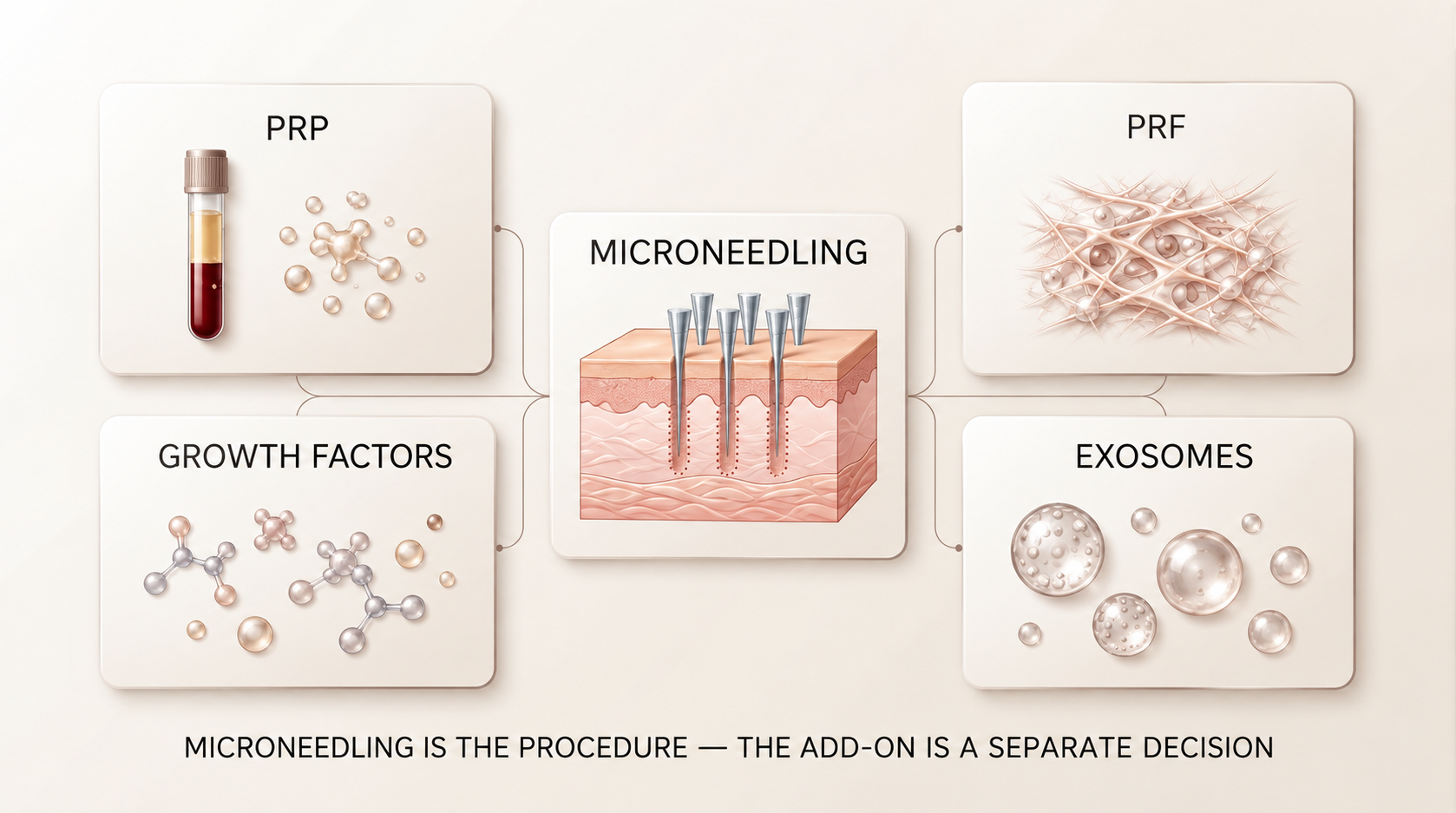
Microneedling is the procedure. The add-on is a separate question.
Microneedling creates controlled microinjury to stimulate a wound-healing response. PRP, PRF, growth-factor preparations, and products marketed as exosomes are sometimes paired with the procedure, but they are not interchangeable and should not be treated as one generic “regenerative serum.”
When evaluating a combination, ask what the add-on is supposed to contribute beyond microneedling itself.
PRP and PRF
PRP and PRF are autologous, meaning they are prepared from the patient's own blood. Processing changes the concentration and matrix of platelets and signaling proteins. Protocols vary, which can make comparisons between clinics and studies difficult.
Their use alongside microneedling is intended to support healing or skin-quality goals, but the magnitude of added benefit depends on indication and protocol.
Growth factors
Growth-factor products can come from different sources and contain different mixtures. “Growth factors” describes biological signals, not one standardized treatment. A topical product and an autologous platelet preparation should not be assumed to behave the same way.
What about exosomes?
Exosomes are extracellular vesicles involved in cell signaling. They are a major aesthetic trend, but marketing claims often exceed the level of clinical standardization. Patients should ask exactly what product is being used, how it is sourced, whether it is being applied topically or administered another way, and what evidence supports that specific use.
In the United States, there are currently no FDA-approved exosome products. That makes precise product identification and regulatory context especially important.
Choosing the right microneedling add-on
Microneedling already creates a biological stimulus. Adding multiple products can increase cost and complexity without guaranteeing a proportionally better outcome.
The most useful combination is the one supported by the patient's diagnosis, the quality of the product, and a reasonable evidence base.
Why delivery route matters
A substance placed on the surface after microneedling is not the same as a substance injected into tissue. Creating channels can change absorption, which makes sterility, formulation, and intended route important. The FDA has not cleared microneedling devices for use with PRP, drugs, cosmetics, or other added products, so combination use should be discussed with that regulatory context in mind.
A product formulated as a cosmetic topical should not automatically be treated as appropriate for injection or deeper delivery.
How to compare combination studies
When a study reports better outcomes from microneedling plus an adjunct, look at what the comparison group received, how outcomes were measured, how many patients were included, and whether the exact preparation resembles what a clinic offers.
Small improvements can be real without proving that an add-on is necessary for every patient.


