

Why Filler Can Look Different in Motion Than at Rest
Updated: Sep 29

INJECTABLES
A face that looks balanced in a still photograph may behave differently while smiling, speaking, or turning. Filler exists within moving tissue, so treatment planning should consider expression and function rather than evaluating the face only at rest.
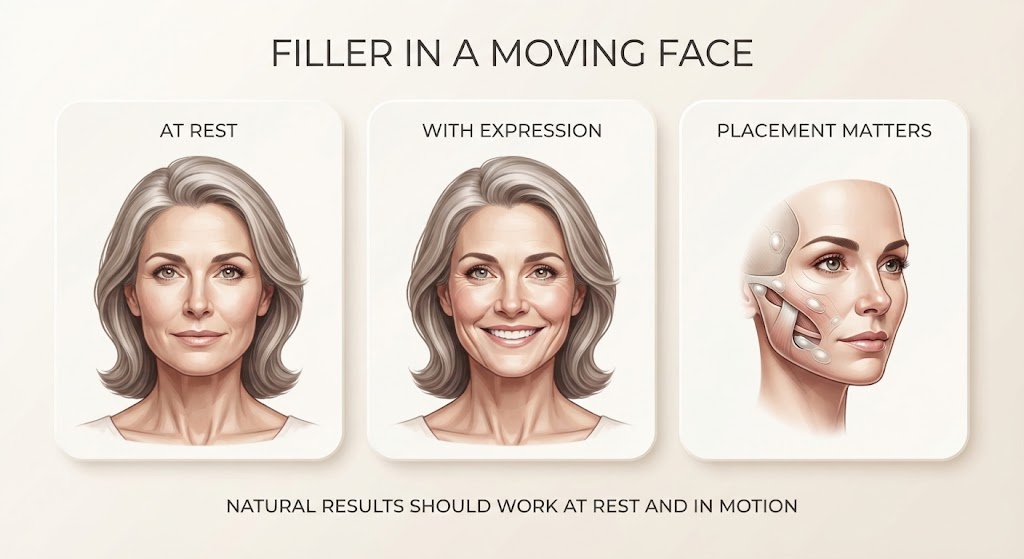
The face is a dynamic structure
Muscles move the lips, cheeks, mouth, and lower face while skin and soft tissue glide over deeper structures. Different regions have different degrees and directions of movement. A treatment that ignores this can look acceptable in one position but less natural during expression.
Why placement matters
The depth and location of filler influence how it integrates with surrounding tissue. Product placed in a highly mobile area experiences different mechanical forces than product used for deeper structural support. This is one reason technique should be adapted to the anatomy and treatment goal.
Why more volume can reduce natural movement
Adding excessive volume can alter the way tissue folds, projects, or moves. In the lips and perioral region especially, chasing size rather than proportion can create stiffness or an appearance that is more obvious during speech and smiling.
Why assessment should include expression
A thoughtful evaluation can include smiling, speaking, frowning, profile views, and changes in head position. This helps distinguish a concern that is structural at rest from one that is primarily created by movement.
Natural-looking treatment is not just about subtle volume
A small amount of filler can still look unnatural if it is placed without regard for anatomy and movement. Conversely, an appropriate amount placed for a specific structural purpose can remain harmonious through expression. The objective is integration, not simply using less product.
Why different areas move differently
The lips, cheeks, chin, and temples do not experience the same mechanical forces. The lips repeatedly compress, stretch, and change shape during speech and eating, while deeper cheek support moves in a different pattern. Product choice and placement therefore need to reflect how much an area moves and what the treatment is intended to accomplish.
A technique that works well for structural support in one region may look or feel inappropriate in a more mobile area.
Why photographs can miss an unnatural result
Still photographs are useful for documenting proportion, but they capture only a fraction of facial behavior. A contour that appears smooth in a neutral pose may bunch, project, or become more obvious during a full smile. Video or observation through several expressions can reveal changes that a standard before-and-after image does not show.
This is especially important when the patient's concern appears only while speaking or smiling.
Product properties also influence movement
Hyaluronic acid fillers differ in firmness, flexibility, cohesivity, and how they integrate with tissue. Those characteristics can influence whether a product is better suited to structural support or an area that needs to remain highly mobile. Product selection is therefore part of preserving natural movement, not simply a choice about how long filler lasts.
The most appropriate product also depends on depth, anatomy, treatment goal, and injector technique.
Why reassessment should happen in motion
Follow-up should consider both the resting result and facial expression. Swelling needs time to settle before subtle movement differences can be interpreted accurately. Once the tissue has stabilized, smiling, speaking, pursing the lips, and viewing the face from several angles can help determine whether the result remains integrated.
If a concern is present, the correction should address its cause rather than automatically adding more volume.


