

Lip Filler Explained: Shape, Hydration, and Why More Is Not Always Better
Updated: Sep 29
INJECTABLES
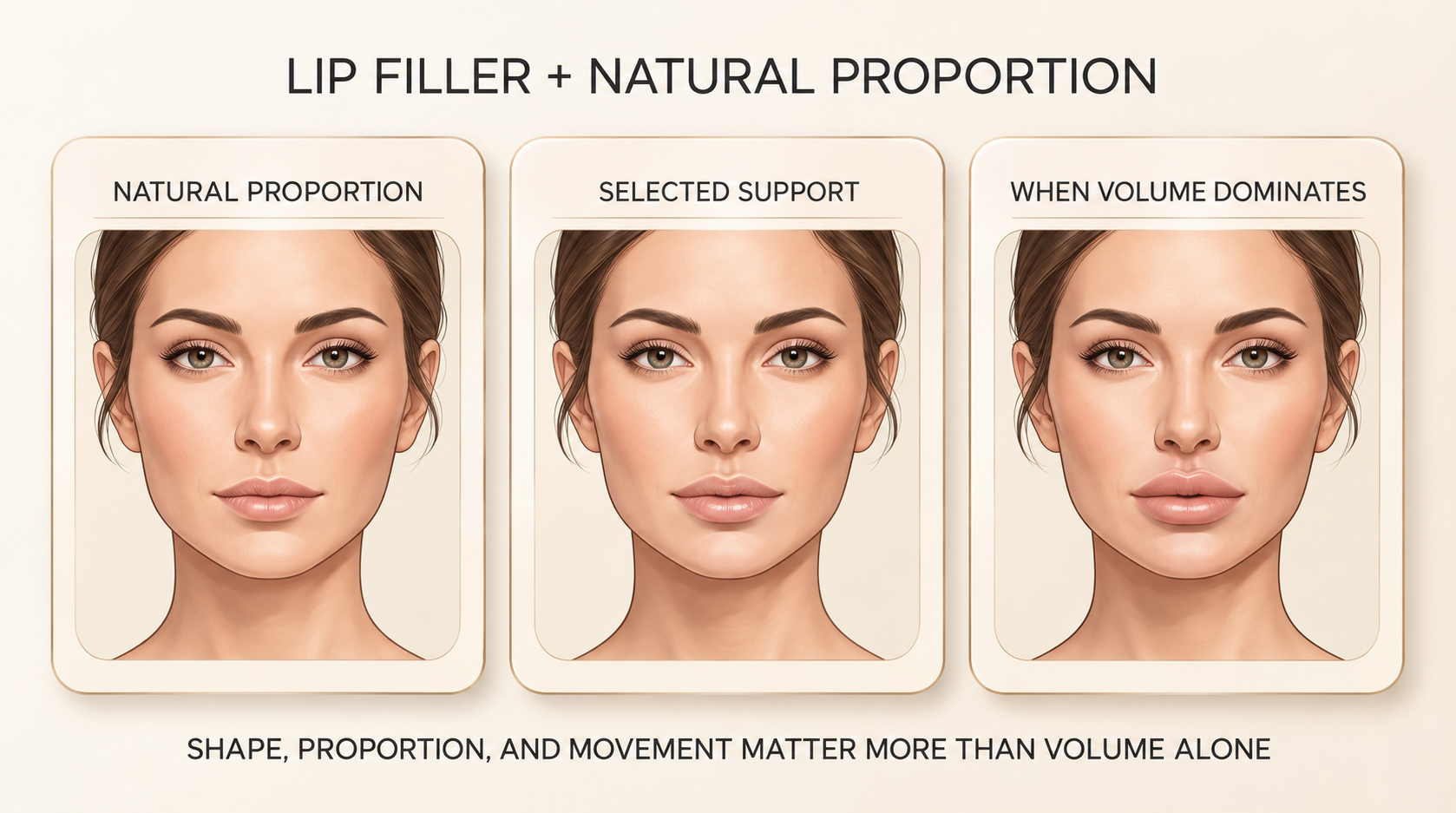
Lip filler is often reduced to a question of volume, but the lips are dynamic structures with distinct borders, columns, tubercles, and movement patterns. A thoughtful treatment plan considers shape and proportion before deciding whether more volume is desirable.
What lip filler can change
Hyaluronic acid filler can add selected volume, support the vermilion border, refine asymmetry, or influence how the upper and lower lips relate to each other. Product softness and placement depth affect how the material moves with expression.
A hydrated appearance may improve when the lip has better internal support, but filler is not the same thing as a topical moisturizer.
Why lip anatomy matters
The lips sit within the larger balance of the chin, nose, teeth, and lower face. A lip shape that looks attractive on one person may look unnatural on another because the surrounding proportions are different.
Dental show, lip length, smile pattern, and baseline asymmetry can all influence the result.
Why overfilling changes movement
Adding repeated volume faster than tissue can accommodate it can blur natural landmarks, reduce definition, and change the way the lip moves. Excess volume may also extend beyond the intended border in some cases.
A staged approach allows time to evaluate both appearance and movement before deciding whether more is appropriate.
What natural-looking lip treatment means
Natural does not mean invisible. It means that the treated lips continue to make sense with the rest of the face and retain recognizable anatomy and movement.
For some patients, the best plan is a small refinement. For others, no filler may be needed at all.
Why migration is not only about product choice
Lip filler migration is influenced by anatomy, injection plane, tissue capacity, repeated treatment, and the amount of product placed over time. Blaming one product characteristic alone oversimplifies the problem.
When filler extends beyond the intended lip boundary, continuing to add volume can compound the distortion. Reassessment may be more appropriate than automatically topping up the area.
The surrounding face changes how lip volume reads
Lip size is interpreted in relation to chin projection, dental support, philtral length, and nose position. A volume that looks balanced in one face may look excessive in another even if the syringe amount is identical.
This is why lip treatment should be planned as part of facial proportion rather than as an isolated feature.
Why conservative treatment is easier to refine
Small increments make it easier to preserve the cupid’s bow, lip border, and natural motion. Swelling should resolve before deciding whether another adjustment is appropriate.
The endpoint is a lip shape that still fits the face and moves naturally, not complete symmetry or the largest volume the tissue can accommodate.
What natural-looking lip filler should preserve
Lip filler is most successful when shape and proportion guide the plan. More volume is not automatically more attractive, and restraint is often what preserves a believable result.


