

Filler Migration Explained: What It Means and What Can Mimic It
Updated: Sep 29

INJECTABLES
Filler migration is a real reported complication, but the term is often used online for almost any contour change after injection. Puffiness, edema, product visibility, overfilling, anatomy, and changes in surrounding tissue can mimic the appearance of product that has moved from its intended location.
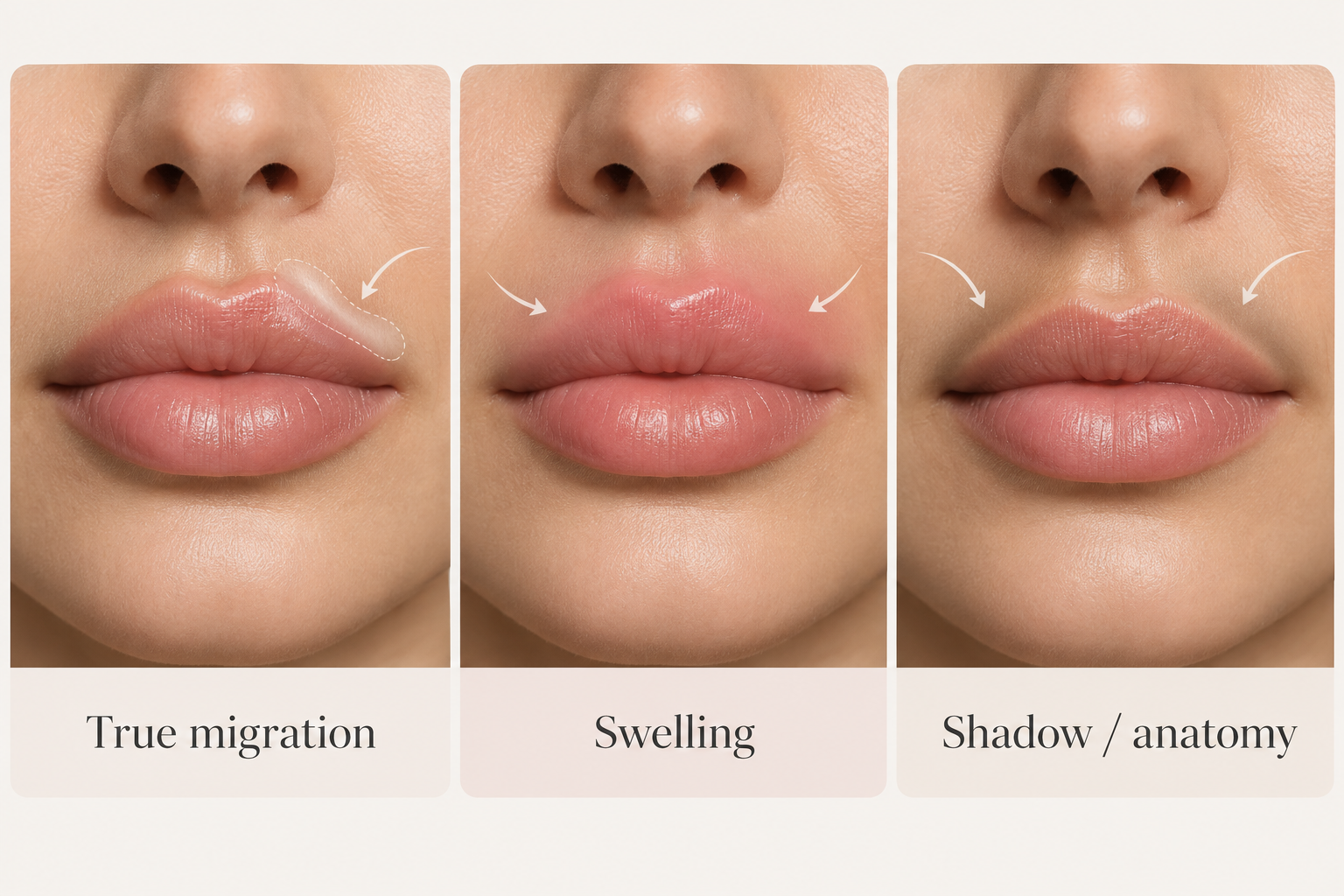
What filler migration means
Migration generally describes filler material being present away from the intended placement area. The likelihood and appearance can depend on product properties, injection plane, volume, tissue movement, anatomy, and time.
What can look like migration
Persistent swelling can blur normal contours. Superficial placement can make product more visible. Excess volume can extend beyond the proportions of the intended area without necessarily representing true migration. Natural anatomy can also become more noticeable after adjacent areas are augmented.
Why lips and under-eyes receive attention
The lips are highly mobile and small changes can be visually obvious. The under-eye region has thin skin and is prone to fluid-related puffiness. Both areas therefore require careful assessment before assuming that an unwanted appearance has one specific cause.
Why diagnosis affects correction
If the issue is swelling, adding more filler or automatically dissolving may not address the cause. If excess or misplaced hyaluronic acid filler is contributing, hyaluronidase may be considered. Other filler materials do not have the same reversal option.
When symptoms need prompt assessment
New severe pain, skin color change, visual symptoms, or other signs concerning for vascular compromise require urgent medical assessment. These symptoms should not be grouped with routine aesthetic dissatisfaction or ordinary post-injection swelling.
Why facial balance matters
A contour change after filler should be interpreted in the context of the surrounding anatomy. Swelling, superficial placement, excess volume, and true migration can look similar but require different decisions.
Swelling and placement can mimic migration
A puffy border or visible fullness outside the intended contour does not prove that filler has physically migrated. Edema, superficial placement, excess volume, anatomy, and scar tissue can create a similar appearance. Correction depends on identifying the cause, which is why evaluation is more useful than assuming every irregularity should be dissolved.


