

Regenerative Aesthetics Explained: PRP, PRF, PDRN, Exosomes, and Biostimulators Are Not the Same Thing

WELLNESS + RESTORATION
PRP, PRF, PDRN, exosomes, and biostimulators are often grouped under “regenerative aesthetics,” but they differ in composition, mechanism, and evidence.
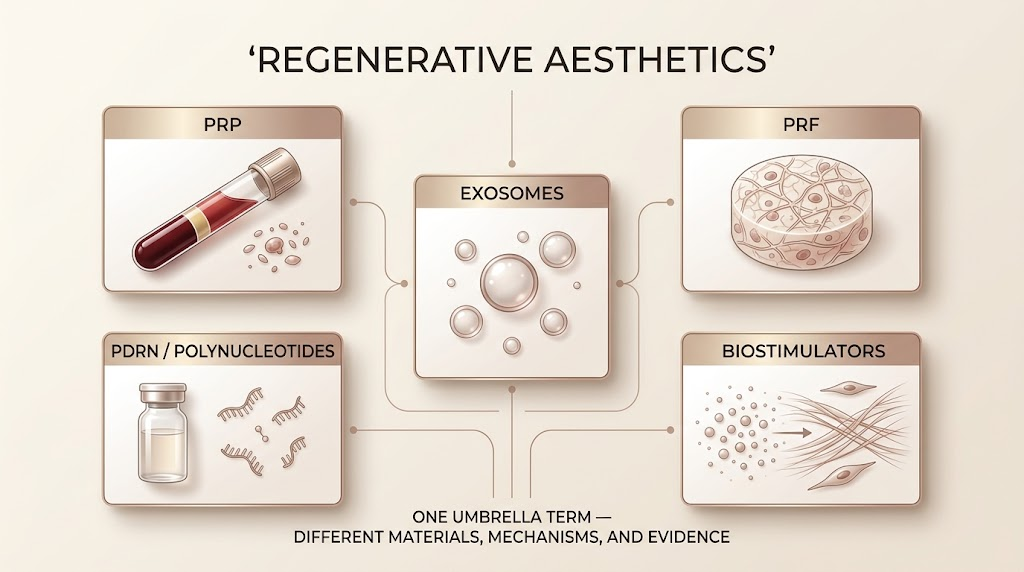
Regenerative aesthetics is an umbrella, not one treatment
PRP, PRF, PDRN or polynucleotides, exosomes, growth factors, and biostimulatory injectables are increasingly grouped under the phrase “regenerative aesthetics.” They do not all work the same way, have the same evidence, or carry the same regulatory status. The term is useful for describing a direction in aesthetics, but it can become misleading when it makes very different technologies sound interchangeable.
The common theme is an attempt to improve tissue quality by supporting or stimulating biological processes rather than relying only on immediate volume replacement.
PRP and PRF
Platelet-rich plasma and platelet-rich fibrin are prepared from a patient's own blood. Processing concentrates platelets and associated signaling proteins, although the final composition depends on the collection and preparation method. They are used in areas such as hair restoration and skin rejuvenation, often as an adjunct rather than a stand-alone solution for every concern.
Because protocols vary, “PRP” is not one perfectly standardized product. Diagnosis and treatment goal still matter.
PDRN and polynucleotides
Polynucleotide-based treatments are attracting attention for skin-quality and repair applications. Early clinical evidence is encouraging, but protocols and products remain heterogeneous. They are not simply another name for PRP and should not be presented as equivalent to filler.
Exosomes and growth factors
Exosomes are extracellular vesicles involved in cell-to-cell signaling. They are scientifically interesting, but consumer marketing has moved faster than clinical standardization. In the United States, there are currently no FDA-approved exosome products. Patients should ask exactly what product is being proposed, how it is sourced, how it would be administered, and what regulatory status and human evidence support that specific use.
Growth-factor preparations are another distinct category. A product containing growth factors is not automatically an exosome product, and neither term guarantees a clinically meaningful outcome.
Biostimulators
Biostimulatory injectables such as poly-L-lactic acid are designed to stimulate collagen production over time. Their evidence base, injection technique, treatment planes, risks, and expected timeline differ substantially from blood-derived or nucleotide-based treatments.
“Regenerative” should therefore be the beginning of the conversation, not the conclusion. The useful question is which specific technology has evidence for the concern being treated.


