

PDRN / Polynucleotides Explained: Why 'Salmon DNA' Is Suddenly Everywhere
Updated: Oct 1

WELLNESS + RESTORATION
PDRN and polynucleotides are drawing attention in aesthetics, but the popular “salmon DNA” label oversimplifies what these products are and how the evidence varies.
Why PDRN and polynucleotides are suddenly everywhere
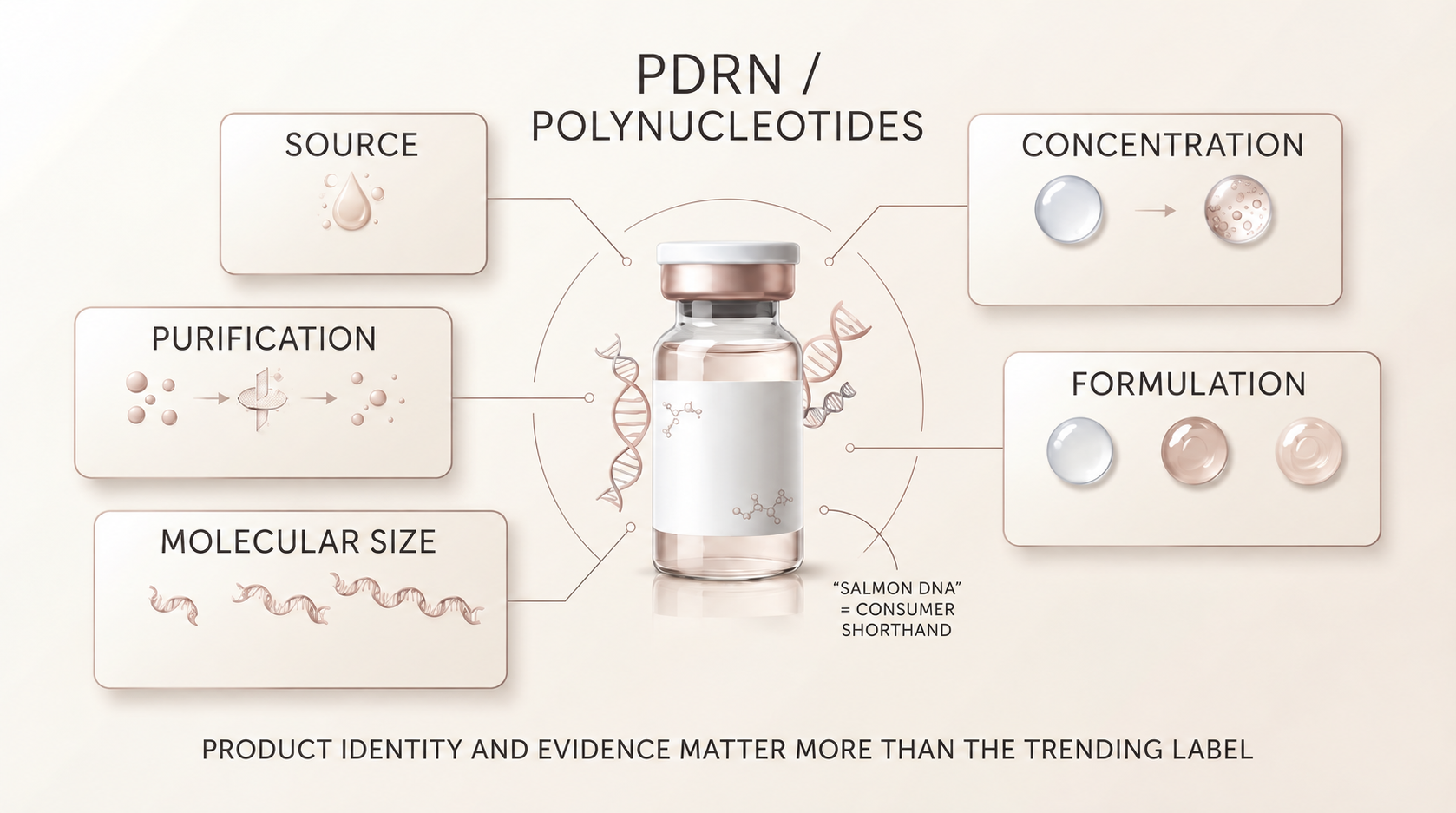
PDRN and polynucleotides have moved quickly from niche regenerative terminology into mainstream aesthetic conversation. Social media often calls them “salmon DNA,” but that shorthand can make the category sound simpler than it is. Polynucleotides are chains of nucleotides, while PDRN refers to shorter DNA-derived fragments. Products, concentrations, delivery methods, and regulatory status can differ, so the name alone does not tell you exactly what is being used.
Interest is being driven by a broader shift toward skin quality, repair, and gradual improvement rather than adding visible facial volume. The important question is not whether a treatment is trending. It is whether the specific product, route of administration, evidence, and treatment goal make sense for the patient.
What the evidence actually suggests
Clinical research is promising but still developing. Published studies have reported improvements in measures such as fine lines, texture, elasticity, hydration, wound healing, and patient satisfaction. At the same time, the studies are relatively small, protocols vary, and there is not yet one standardized aesthetic regimen that applies to every product or treatment area.
That means strong claims such as “regenerates your skin” or “reverses aging” go beyond what current evidence can reliably prove. A more accurate expectation is that selected polynucleotide-based treatments may support certain skin-quality goals, while the magnitude and durability of benefit remain product- and protocol-dependent.
PDRN is not the same as filler
Traditional hyaluronic acid filler is primarily used to create or restore volume and contour. Polynucleotide treatments are generally discussed in the context of skin quality and tissue response. They should not be expected to create the same structural projection as cheek, chin, or lip filler.
This distinction matters when patients are trying to avoid an “overfilled” appearance. Choosing a non-volumizing treatment does not automatically mean it can replace volume where structural support is actually needed.
What to ask before treatment
Ask what exact product is being used, how it is administered, what evidence supports that use, and what side effects are expected. Also ask whether the exact product is FDA-approved for any use in the United States and, if so, whether the proposed aesthetic use is on-label or off-label. An unapproved product is not the same thing as an approved product being used off-label.
At MajorGlow, our approach to emerging treatments is the same as established ones: understand the mechanism, evaluate the evidence, match it to the concern, and avoid letting a trend substitute for clinical judgment.
Why product identity matters
The words PDRN and polynucleotide are sometimes used loosely in consumer marketing. Source material, purification, molecular size, concentration, formulation, and intended route of administration can differ between products. Those details affect what can reasonably be inferred from a study performed with a different formulation.
This is especially important when a treatment seen overseas becomes popular online before the same product or indication is available in the United States. Evidence for an ingredient category should not automatically be treated as evidence for every product carrying similar language.


