

Melasma Explained: Why Pigment Can Be Difficult to Treat
Updated: Sep 30

LASER + ENERGY
Melasma usually appears as symmetric brown or gray-brown patches, commonly on the face. It is influenced by a combination of pigment biology, ultraviolet exposure, visible light, heat, hormones, and individual susceptibility. Because those triggers can persist, melasma behaves differently from a single isolated lentigo or freckle.
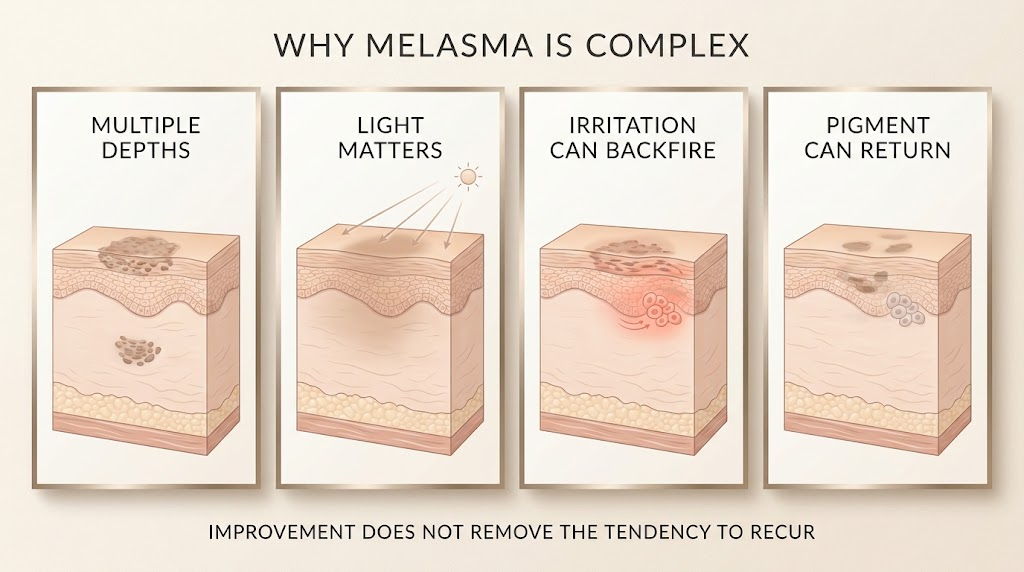
Why melasma is not just excess surface pigment
Pigment can be distributed at different depths, and the condition is influenced by signaling between melanocytes, keratinocytes, blood vessels, and other skin structures. That complexity helps explain why one treatment rarely creates a permanent solution.
Aggressive irritation can also stimulate additional pigment in susceptible skin.
Sun and visible light matter
Ultraviolet exposure is a major trigger, and visible light can also contribute in some patients. Daily protection therefore matters even when active treatment is underway.
A treatment plan that ignores ongoing light exposure may produce improvement that is difficult to maintain.
Why lasers require careful selection
Laser and energy treatments can help selected pigment concerns, but melasma is not simply a target that should be treated with more energy. Heat and inflammation can provoke recurrence or post-inflammatory hyperpigmentation in some patients.
Conservative settings, correct wavelength selection, and careful patient selection are essential when devices are considered.
Topical treatment often remains important
Skin-care ingredients that influence pigment production, cell turnover, inflammation, or barrier function may be used as part of a broader plan. Tolerance matters because chronic irritation can undermine the goal.
Medical guidance is appropriate when prescription therapy is being considered.
Maintenance is part of treatment
Melasma often waxes and wanes. Hormonal changes, seasons, sun exposure, heat, and irritation can all influence recurrence.
A realistic plan focuses on control and maintenance rather than promising permanent clearance.
Why heat can matter even without sun exposure
Some patients notice melasma worsening with heat exposure even when ultraviolet exposure is limited. The exact biology is complex, but vascular and inflammatory signaling may contribute to pigment activity in susceptible skin.
This helps explain why a plan based only on sunscreen and pigment removal may still fall short for some patients.
Why success should be measured as control
Melasma often improves and recurs, so a realistic endpoint is durable control with fewer or lighter patches rather than a promise that pigment will never return.
Maintenance skin care and trigger reduction are part of the treatment, not signs that the original treatment failed.
Why control of triggers matters after treatment
Melasma remains biologically active even after patches fade. Ultraviolet light, visible light, heat, hormonal influences, and irritation can all contribute to renewed pigment production.
For melasma, photoprotection and a tolerable long-term topical routine are core parts of control rather than optional aftercare.
How to recognize when the strategy needs to change
If melasma becomes more reactive after repeated procedures, escalating energy can worsen the cycle. A calmer maintenance strategy or revised treatment plan is often more appropriate.
Success with melasma is usually measured as durable control, fewer flares, and lighter recurrence rather than a promise of permanent clearance.
What to remember about treating melasma
Melasma is a chronic pigment tendency, not simply a collection of dark spots. Successful management usually combines trigger reduction, skin protection, and carefully selected treatment rather than relying on one aggressive procedure.


