Hyaluronic Acid Filler Dissolving Explained: What Hyaluronidase Can and Cannot Do
Updated: Sep 29

INJECTABLES
Hyaluronidase is an enzyme that breaks down hyaluronic acid. In U.S. aesthetic practice it is commonly used off-label to reduce or dissolve hyaluronic acid filler, but filler dissolution is not an FDA-approved indication for hyaluronidase. The process should not be treated as a simple reset button: the reason for dissolving, the filler involved, anatomy, and urgency all matter.
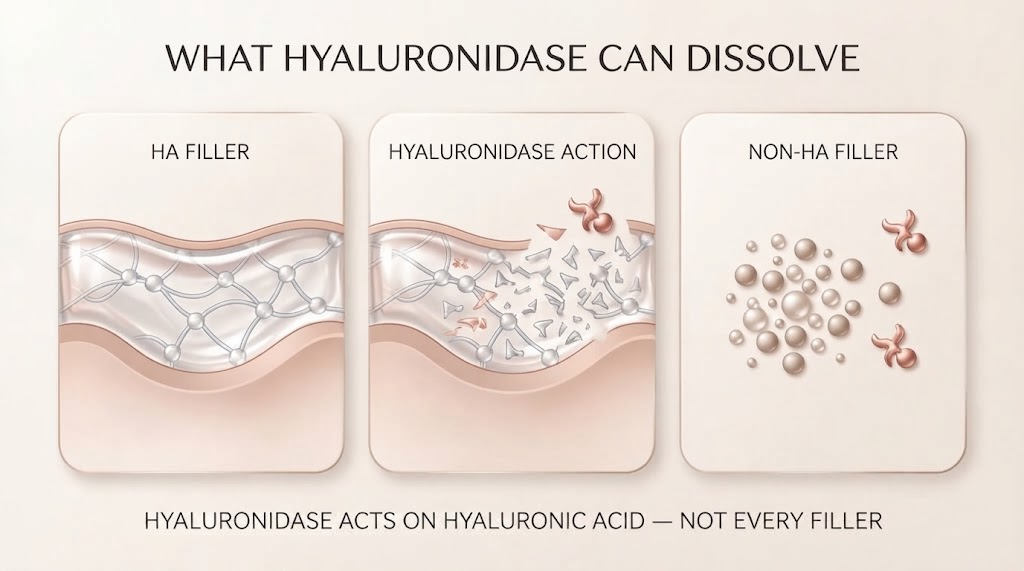
Which fillers can be dissolved with hyaluronidase?
Hyaluronidase acts on hyaluronic acid. It is not a specific reversal agent for fillers made from calcium hydroxylapatite, poly-L-lactic acid, polymethylmethacrylate, or other non-HA materials. Knowing what product was injected is therefore important before planning removal.
Why someone might consider dissolving filler
Reasons can include unwanted contour, persistent puffiness, asymmetry, palpable product, migration concerns, or a change in aesthetic preference. Some complications require a different medical approach, and suspected vascular compromise is an urgent clinical situation rather than a routine cosmetic correction.
Why the result is not perfectly predictable
Different HA fillers vary in concentration and crosslinking, and product can be distributed across tissue planes. The amount of enzyme and the response can therefore vary. More than one treatment may be needed, while overly aggressive dissolving can create an unwanted change in contour.
Hyaluronidase has its own risks
Dissolving treatment can cause swelling, bruising, discomfort, and allergic reactions. The decision to use it should weigh the reason for reversal against the risks of another injection procedure.
Elective dissolving and emergency use are different
Hyaluronidase may be used off-label electively to correct an unwanted hyaluronic acid filler result, and off-label use is also part of accepted emergency management for suspected vascular compromise from HA filler. These situations should not be approached the same way. Cosmetic dissatisfaction allows time for examination, discussion, and staged correction, while vascular symptoms require immediate clinical assessment and a complication-management protocol.
Why product history matters
Knowing the filler brand, amount, injection date, and treatment area can make the dissolving plan more informed. Different hyaluronic acid gels vary in concentration, particle characteristics, and degree of crosslinking, which can influence how readily they respond. When treatment records are unavailable, the clinician may need to rely more heavily on examination and, in selected cases, imaging such as ultrasound.
Why staged dissolving can be useful
For non-urgent correction, smaller staged treatments may make it easier to judge how much filler remains and whether the original contour concern has improved. Swelling from the dissolving injection itself can temporarily obscure the result, so immediate appearance is not always the final appearance. Reassessment after the tissue settles can reduce the temptation to overcorrect.
What happens to the skin's own hyaluronic acid
Hyaluronidase is not able to distinguish perfectly between injected hyaluronic acid and naturally occurring hyaluronic acid in the surrounding tissue. Some native hyaluronic acid can be affected temporarily, which may contribute to short-term changes in hydration or contour. The body continually produces and turns over its own hyaluronic acid, so this is different from permanently removing a structural component of the skin.