

Cheek Filler Explained: Midface Support, Proportion, and Aging

INJECTABLES
The cheeks play an important role in facial proportion because the midface helps frame the eyes, supports the transition toward the lower face, and contributes to how light and shadow move across the face. Cheek filler can influence these relationships, but adding volume without understanding the anatomy can easily create heaviness instead of support.
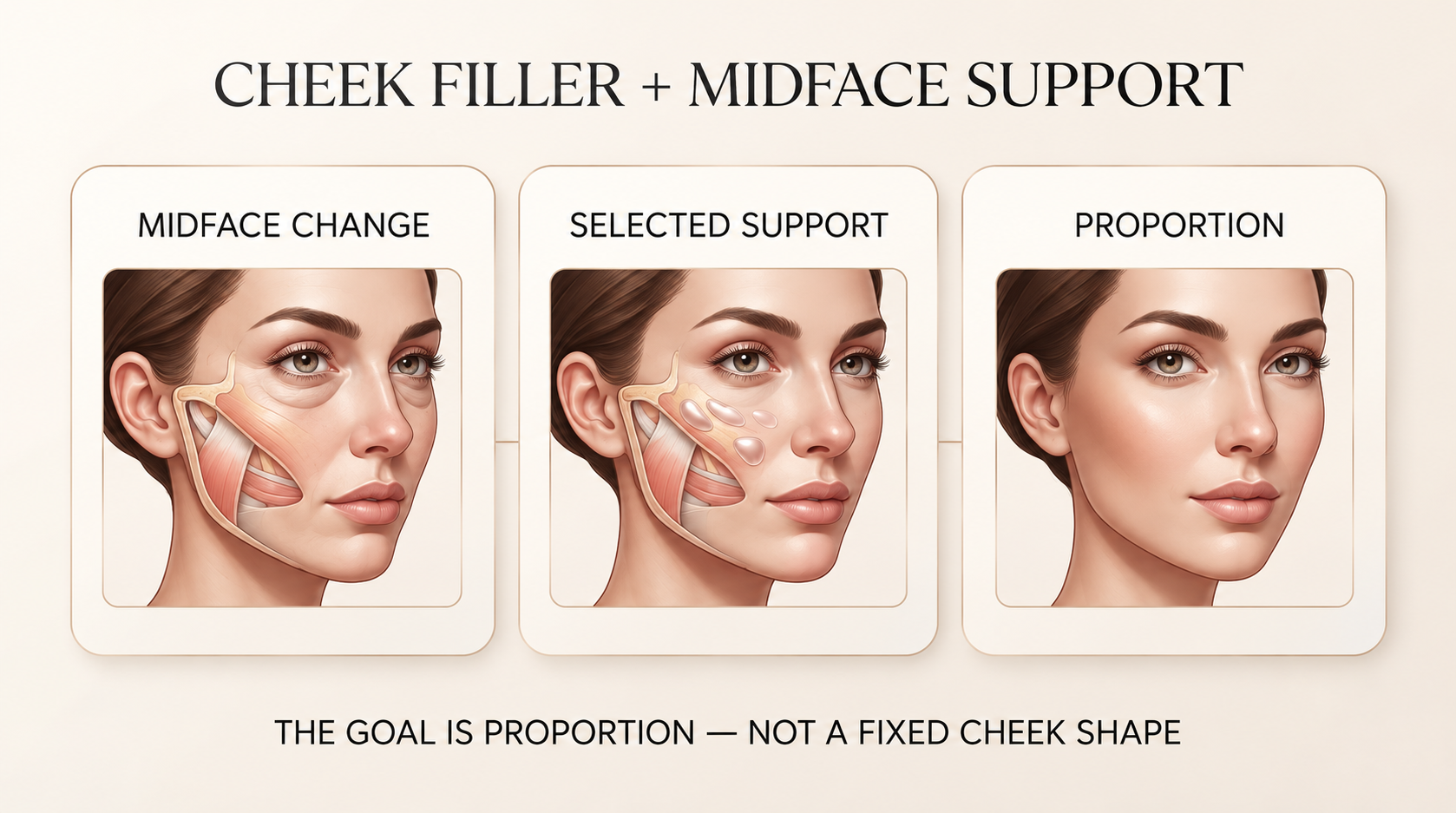
What changes in the midface over time
Facial aging involves changes in bone, fat compartments, ligaments, skin, and muscle. In the midface, these changes can reduce projection or alter the way volume is distributed, which may make the lower face or under-eye region appear more prominent.
Not every flat or tired-looking cheek reflects true volume loss. Natural skeletal shape and soft-tissue distribution vary widely.
What cheek filler can do
Strategically placed filler can create selected projection, support a contour transition, or restore some volume where tissue has changed with age. Product choice and depth of placement influence whether the result looks structural, soft, or mobile.
The goal is usually proportion rather than a fixed cheek shape.
What cheek filler cannot do
Filler cannot tighten significant skin laxity, erase every nasolabial fold, or replicate a surgical lift. It also cannot change the underlying skeleton in the same way that an implant or surgery can.
Trying to solve every aging concern by adding more midface volume can make the face look wider or heavier.
Why less can be more
A small amount placed in the right location may have more visual impact than a larger amount distributed broadly. Conservative planning also makes it easier to reassess facial balance after swelling resolves.
Treatment can be staged rather than trying to reach an endpoint in one appointment.
Why cheek position matters more than cheek size
Aesthetic treatment is often described in terms of adding volume, but the location of that volume usually matters more than the total amount. Support placed too low or too laterally can widen the face or create heaviness even when the total volume is modest.
Treatment planning should identify where the face has actually lost support and where additional volume would distort rather than restore the natural contour.
How overcorrection changes the lower face
Excessive midface volume can push visual weight downward and outward, which may make the lower face appear heavier instead of more lifted. It can also change the relationship between the cheek, under-eye, and nasolabial region in ways that feel less natural.
Stopping before the cheek becomes the dominant facial feature is often what preserves a balanced result.
How to evaluate progress
Immediate appearance is not always the final result. Swelling, redness, hydration changes, and healing can temporarily alter what is visible.
Standardized photographs and clear baseline goals make it easier to decide whether treatment should continue, change, or stop.
What cheek filler can realistically improve
Good cheek filler is about restoring or refining proportion, not simply adding fullness. The most natural plans respect the patient's underlying facial structure and stop before support becomes heaviness.

