

Chin Filler Explained: Projection, Profile Balance, and Patient Selection
Updated: Sep 29

INJECTABLES
The chin anchors the lower third of the face. Small differences in projection, width, height, and asymmetry can influence how the lips, jawline, and neck are perceived. Filler can modify selected aspects of chin contour, but it cannot reproduce every change that surgery or orthodontic treatment can create.
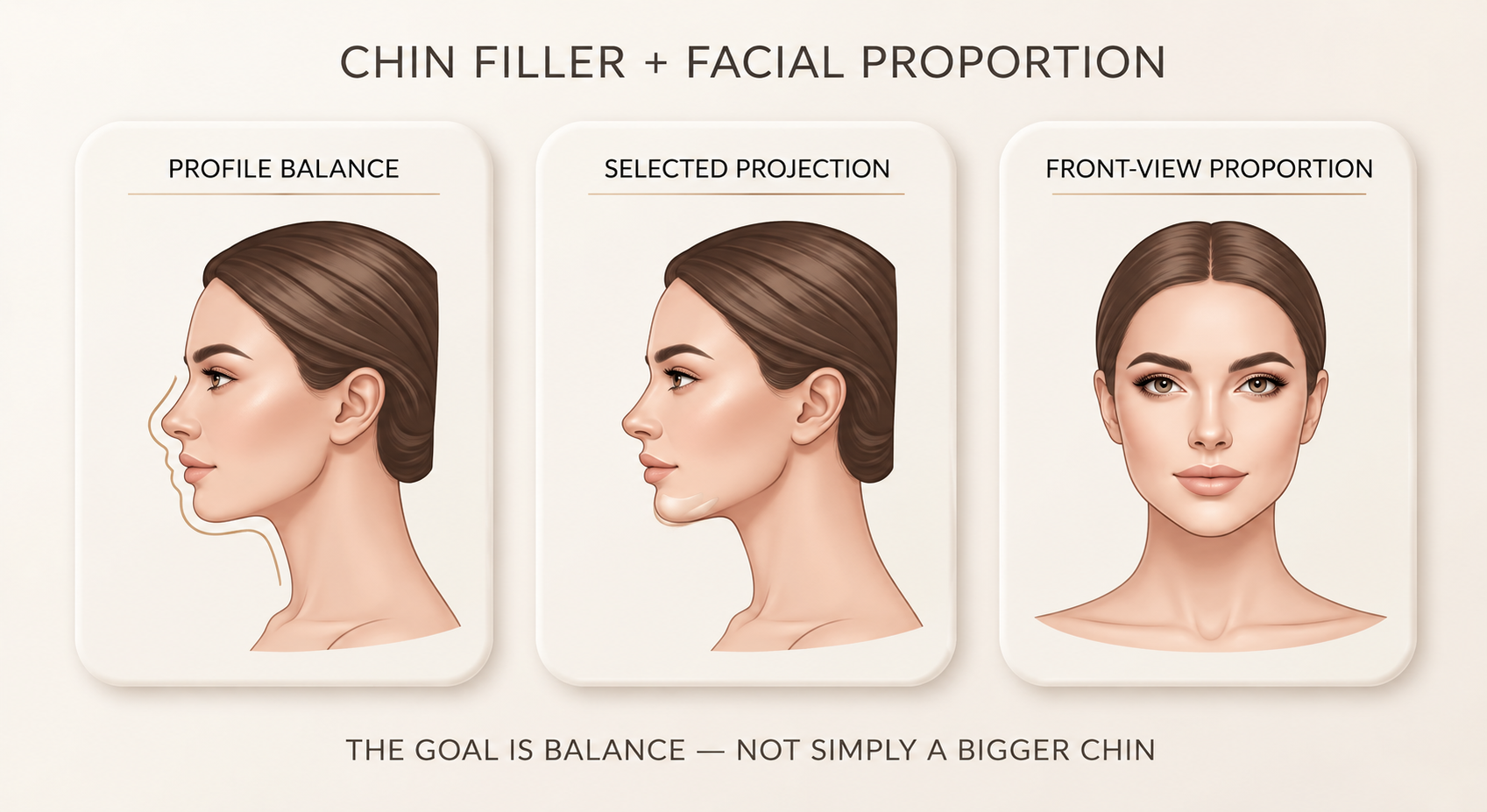
What chin filler can influence
Depending on anatomy, filler can add forward projection, refine the transition into the jawline, or create selected vertical or lateral contour. Product choice and placement determine whether the effect is subtle or more structural.
The goal is usually to improve proportion rather than to make the chin look larger in isolation.
Why the profile matters
Chin projection affects the apparent relationship between the nose, lips, and neck. A relatively retrusive chin can make other features seem more prominent even when those features are normal.
Profile assessment helps prevent treating the lips or jawline alone when the chin is contributing to the imbalance.
What filler cannot correct
Filler cannot reposition the jaw, correct a significant bite problem, or reproduce the skeletal change of genioplasty. It also cannot tighten loose neck skin or eliminate submental fat.
When the structural issue is large, adding enough filler to compensate may create an unnatural amount of soft-tissue volume.
Why front-view balance also matters
A chin that looks balanced in profile can still appear too narrow, too wide, or asymmetric from the front. Treatment therefore should be planned in more than one view.
Small asymmetries are common and do not always require correction.
Conservative treatment supports reassessment
Because the chin can have a strong effect on the overall face, incremental treatment allows the injector and patient to reassess proportion after swelling settles.
Stopping at the point of balance is usually more important than reaching a predetermined syringe amount.
Why chin treatment can affect the jawline without touching it
Forward or vertical chin support can change how the jawline reads because the chin forms the front endpoint of the mandibular contour. In some faces, a small change in chin projection creates more visual improvement than distributing filler broadly along the jaw.
That effect does not mean the jawline itself has changed structurally. It reflects a shift in proportion and the way the eye connects the lower-face contours.
When structural referral may be more appropriate
Marked retrusion, bite problems, facial asymmetry, or significant skeletal imbalance may extend beyond what filler can reasonably compensate for. In those cases, orthodontic, maxillofacial, or surgical evaluation may be more appropriate.
Filler works best when it refines a moderate contour concern rather than masking a major skeletal discrepancy with soft-tissue volume.
What chin filler can realistically change
Chin filler is a structural treatment, not simply a way to add volume. The best outcomes come from understanding how the chin relates to the entire lower face and recognizing when filler is not the right tool.


